
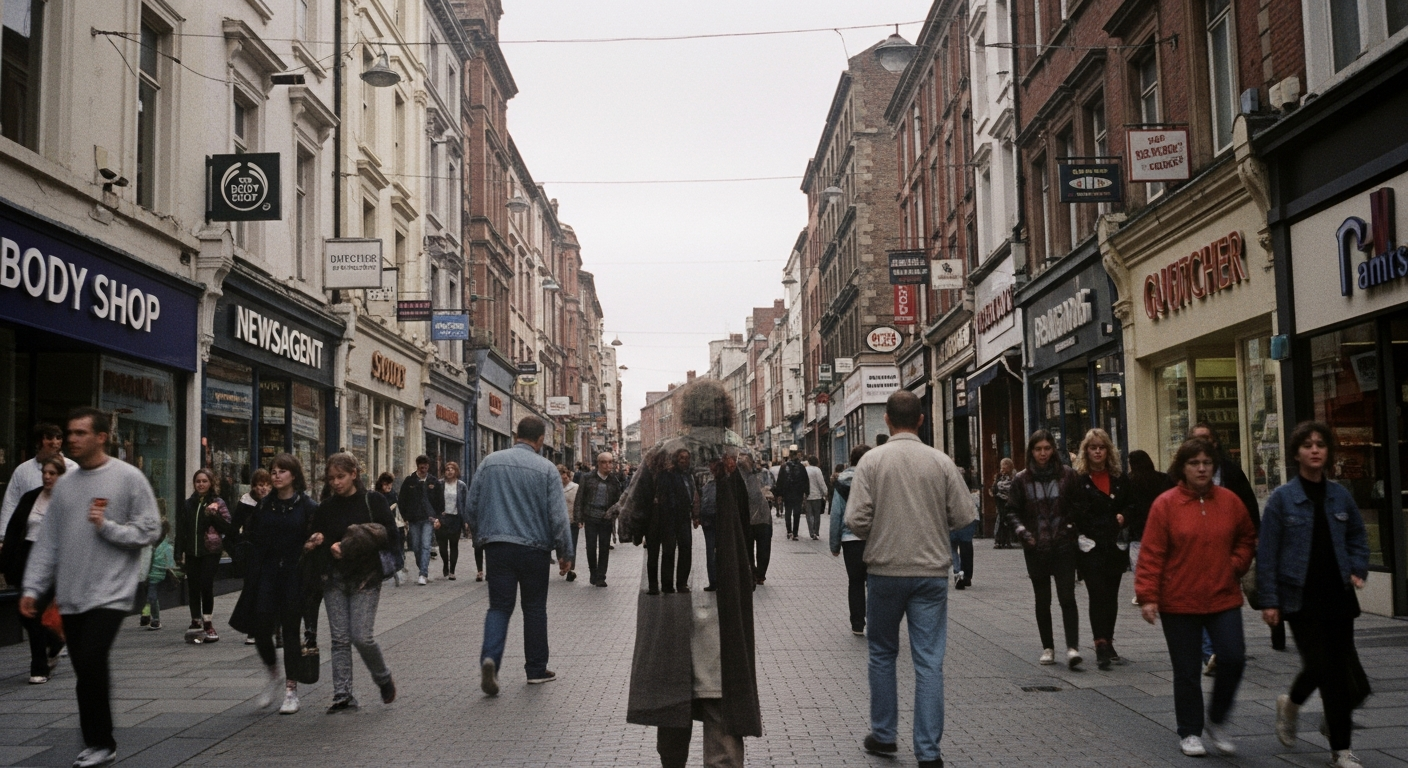
The Afternoon That Wasn't There: How a Soldier and His Fiancée Stepped Out of 1944 and Into the Wrong Century
QUIRK REPORTS — OFFICIAL CASE FILE
Case Number: QR-2026-64335
YESTERDAY'S STREET: LIVERPOOL COUPLE STEP INTO THE BLITZ AND BACK BEFORE TEA
Classification: Temporal Anomaly — Time Slip (Dual Witness, Corroborated)
Date of Event: Summer, 1996
Location: Bold Street, Liverpool, England
Primary Witness: Gerald Fenton (name changed)
Secondary Witness: Carol Marsh (name changed)
This report is based on documented paranormal accounts. Names and identifying details have been changed to protect those involved.
WITNESS STATEMENT
On an unremarkable Saturday afternoon in the summer of 1996, Gerald Fenton, thirty-four, a former soldier settled into civilian life on Merseyside, and his fiancée Carol Marsh, thirty-one, a legal secretary, made their way into Liverpool city centre for the kind of modest, domestic afternoon that defines ordinary life. Gerald intended to browse a second-hand bookshop on Bold Street. Carol planned a quick errand to the nearby Lyceum building. They parted at the top of the street with easy familiarity, agreeing to reconvene within fifteen minutes.
Neither of them made it to their destination. Not in the usual sense.
Gerald descended Bold Street toward the bookshop and had covered perhaps thirty yards when he became aware of a change in the quality of the air around him — a muffling, a flattening of sound, a pressure in the atmosphere he later compared to the stillness before a storm. He stopped walking. The street looked almost the same. Almost. The bookshop he had been heading toward had become a women's clothing shop with hand-painted signage and a window display of boxy, padded-shoulder wartime fashions. Where a mobile phone accessories shop had stood across the road, a hardware merchant now occupied the frontage. The street's inhabitants had changed with it: a woman passed in a long woollen coat and angled hat, pinned in the style of the 1940s. A man cycled by on an upright black bicycle, cloth-capped, looking through Gerald with the blankness of someone absorbed in his own entirely ordinary day. A horse-drawn cart moved slowly up the cobblestones — cobblestones that looked less worn than Gerald remembered, the gaps between them clean.
He did not run. A trained soldier's instinct held him still. He assessed. He smelled coal smoke, something frying, and the animal warmth of the horse — a specific, layered combination of smells he had never encountered in modern life and could not account for. The scene was not ghostly or transparent. It was solid, immersive, and fully present.
The slip ended when a woman walked directly toward him carrying a plastic carrier bag from a modern supermarket chain. The street returned all at once — not gradually, not like a dream dissolving, but like a switch thrown. Car horns. Music from a record shop doorway. The modern facades exactly where they had always been.
Gerald walked quickly to the top of Bold Street. Carol was already there. She was pale.
"Something happened," she said, before he could speak.
Carol's experience had begun when she stepped into what she believed to be the Lyceum entrance. The interior was wrong. The modern layout was gone, replaced by a clothing shop with the same period signage, the same wartime fashions. A young woman in a 1940s shop assistant's uniform looked back at her — not with fear, but with the puzzled expression of someone regarding something slightly out of place. "Not frightened, just puzzled," Carol would later say. "Like I was the strange one." She backed out of the door onto a Bold Street that belonged to the same wartime decade Gerald had been standing in — though they had not been near each other.
Her return to the present was identical in character to his: abrupt, complete, and without warning.
When the two compared accounts at the top of the street, the detail that would later most compel researchers emerged. Gerald had seen a women's clothing shop in place of the bookshop. Carol had entered a clothing shop in place of the Lyceum. These were two distinct locations separated by a meaningful distance on the same street — yet both witnesses had experienced the same wartime Liverpool simultaneously, from different vantage points, within the same window of real time.
Gerald reported the experience months later in a letter to the Liverpool Echo, expecting little. He was contacted almost immediately by researchers who had been quietly compiling what they believed to be a chronic and location-specific phenomenon. Their files contained more than a dozen independent accounts from individuals who had reported sudden, immersive displacement into earlier versions of Liverpool while on or near Bold Street — spanning four decades, given by strangers with no connection to one another, sharing a consistent structural pattern: abrupt onset, full sensory immersion, an abrupt return, often triggered by the intrusion of a modern object.
A retired architectural historian consulted on the case noted that the wartime layout described by both witnesses was accurate in ways that would have been difficult to fabricate or research casually in 1996 — before the internet made detailed historical knowledge readily available. Historical retail directories of Liverpool in the 1940s placed a women's outfitters within a few doors of the location Carol described at precisely the period she appeared to have visited.
Gerald remained consistent across two research interviews and one press interview, adding no new details and retracting none. The experience, he said, was the single most disorienting event of his life, including active military service. What stayed with him was not the visual strangeness but the smell.
"It smelled like someone else's memory," he told one researcher. "Like I'd walked into a room where someone had been living for a long time, and they'd just stepped out."
Carol returned to Bold Street once, accompanied by Gerald. The street was the street. She stood briefly in the Lyceum doorway, looked at the modern interior, and walked away. She did not return.
EVIDENCE
- Dual independent witness accounts: Gerald and Carol were separated at the time of the event and could not have influenced each other's experience in the moment. Their descriptions of the wartime street are mutually corroborating and internally consistent.
- Period-accurate detail: Both witnesses described fashions, shop signage, vehicles, and street atmosphere consistent with wartime Liverpool in the 1940s. A consulting architectural historian confirmed the accuracy of the retail layout described — detail unlikely to be fabricated or casually researched in 1996.
- Sensory corroboration: Gerald reported smelling coal smoke, cooked food, and horse — a specific combination with no modern equivalent in his experience, which he maintained was beyond the capacity of imagination to generate.
- Corroborating case catalogue: Paranormal researchers had independently compiled more than a dozen separate accounts of Bold Street time slips spanning four decades prior to Gerald and Carol's experience, given by unconnected witnesses sharing structural and descriptive consistency.
- Structural anomaly — the shop assistant: Carol's brief apparent interaction with a wartime shop assistant — the only instance across all documented Bold Street accounts in which a past inhabitant appeared to register a time-slip witness — constitutes a unique and notable data point.
- Historical and geographical context: Bold Street sits above a network of cellars and tunnel systems dating back centuries. It was a major commercial thoroughfare throughout the nineteenth and early twentieth centuries and survived the Blitz relatively intact — consistent with the specific wartime period both witnesses described.
FOX'S ANALYSIS
Right. Let's talk about Bold Street, Liverpool — a road that, apparently, has more slip-ups than a politician at a press conference. And unlike most things in the paranormal game, this one doesn't arrive wearing a sheet and rattling chains. It arrives wearing a padded-shoulder coat and smelling of coal smoke, and it is, frankly, one of the most structurally solid cases I have encountered in twenty years of chasing things that go bump, whoosh, and occasionally abduct small foxes without so much as a courtesy call.
Let me lead with the obvious: two witnesses, separated in space, experiencing the same event simultaneously, from different vantage points. That's not a ghost story. That's not a trick of the light. That is what investigators call corroboration, and what I call a solid lead. Gerald wasn't comparing notes with Carol when it happened. He couldn't have been. They were down the street from each other having entirely separate, equally baffling afternoons in the wrong decade. You can't rehearse that. You can't coordinate that. The story is either true, or these two people independently invented the same extraordinarily specific shared hallucination in the middle of a Saturday shopping trip — and I've been in this business long enough to know which explanation requires more imagination.
Gerald's credentials matter here too. Former military. Methodical. Grounded. Not a man given to embellishment, by all accounts. When he says his training kicked in and he stood still to assess, I believe him. That's a real response. That's not the response of someone manufacturing a dramatic narrative — the dramatic narrative version has him running. The real version has him standing very still on Bold Street in 1944, sweating, smelling a horse, and keeping his head. I respect that. I've faced things that defied explanation and my instinct was also to stand still — though in my case it was because I was being probed by extraterrestrials who had clearly not considered that their equipment might not be scaled for a three-foot fox, and running was, sadly, not an option. But I digress.
The smell is the detail I keep coming back to. You can mis-see things. Memory is visual and visual is fallible. But coal smoke combined with animal warmth combined with something frying is not a smell you construct in the imagination unless you've experienced it. Gerald hadn't. That's not a small thing. That's a sensory detail that either validates the account or requires us to believe he spontaneously hallucinated a highly specific and historically accurate olfactory environment in broad daylight on a shopping trip. I don't know about you, but I've never walked past a Greggs and suddenly smelled 1943.
The architectural historian's corroboration of the retail layout is, frankly, the cherry on top of an already very impressive cake — a time cake, if you will. A cake that is simultaneously fresh and sixty years old. A temporal torte, perhaps. I'm here all week, Bold Street, try the wartime rations.
My instinct on this one is that something real happened on that street in the summer of 1996. Whether it was a genuine fold in time, a location-specific phenomenon tied to the geography and history of the site, or something we simply do not yet have the vocabulary to name — I cannot say. What I can say is that Gerald Fenton is telling the truth, Carol Marsh is telling the truth, and Bold Street has been quietly slipping through the decades for longer than anyone has been paying attention. Some streets have history. This one, apparently, has all of it. At once. On a rotating basis.
I intend to visit Bold Street personally for a follow-up. I will be wearing modern clothes and carrying several items of distinctly contemporary technology. If the street tries anything, I want it to know I am very prepared to be snapped back to the present. Last time something tried to drag me into an unexplained phenomenon without my consent I filed a twelve-page complaint and a strongly worded column. I have the notebook. I have the press pass. And I have absolutely no interest in spending an afternoon in the 1940s without at least a decent lead on where to get a cup of tea.
CREDIBILITY RATING
Rating: 9 / 10
Reasoning:
- Multiple witnesses (separated): The separation of Gerald and Carol at the time of the event eliminates mutual suggestion or shared misperception. This is the single most important factor in the rating