
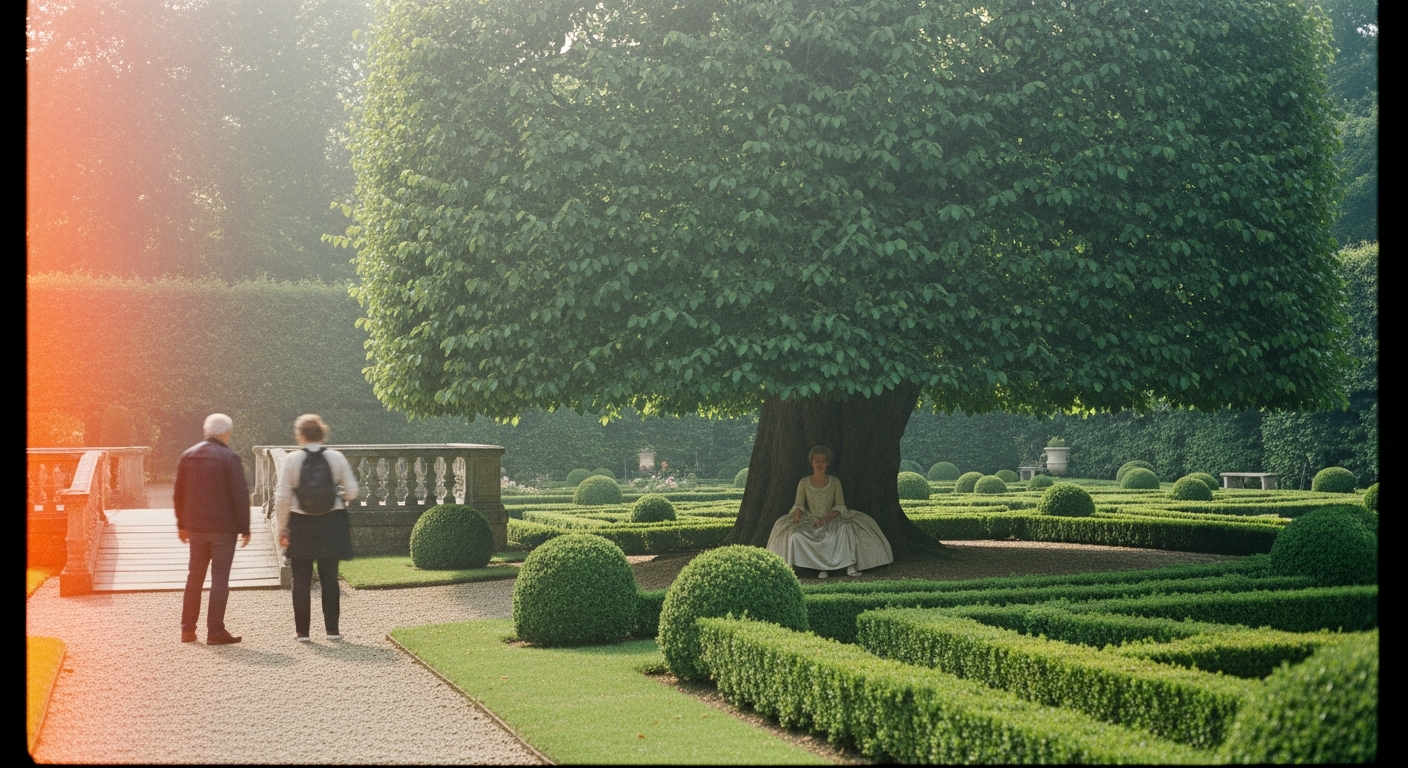
The Afternoon That Refused to End: How Two Women Strolled Into a Vanished World and Came Back Changed Forever
QUIRK REPORTS — OFFICIAL CASE FILE
Case Number: QR-2026-16929
TITLE: LOST IN VERSAILLES: TWO ACADEMICS TAKE A WRONG TURN AND END UP IN THE 18TH CENTURY
Classification: Time Slip — Verified Historical Landscape Intrusion
Date of Incident: 10 August 1901
Location: Petit Trianon, Palace of Versailles, Versailles, France
Witness(es): Charlotte Pemberton (primary), Frances Doyle (corroborating)
Report Filed By: Fox Quirk, Founder & Senior Paranormal Correspondent, Quirk Reports
This report is based on documented paranormal accounts. Names and identifying details have been changed to protect those involved.
WITNESS STATEMENT
On a warm afternoon in early August 1901, Charlotte Pemberton and her colleague Frances Doyle — both experienced academics of considerable professional standing — made a spontaneous decision to walk from the main palace buildings of Versailles out to the Petit Trianon, the smaller royal retreat nestled in the park's western grounds. They carried no map. They simply walked. What followed would occupy the next decade of their lives.
The route began unremarkably. Gravel paths wound between manicured hedgerows, and the ambient sounds of a busy heritage site — footsteps, conversation, the low mechanical rumble of the modern world — accompanied them comfortably. Then, at a point neither woman could precisely identify afterwards, something changed. Not dramatically. Not with any thunderclap of supernatural announcement. The light shifted. The air grew heavier. The sounds of the park ceased entirely.
Charlotte would later describe the sensation as stepping from a bright room into a different room altogether — one where the light came from the wrong direction.
Frances was characteristically more direct: It felt as though someone had turned the world down.
The landscape around them had altered in ways that were subtle but cumulative and deeply wrong. A stone bridge now crossed a stream that appeared on no guidebook or map either woman had consulted. A cottage stood in a clearing ahead — occupied-looking, architecturally incongruous with a public heritage site, and wholly out of place. Near it sat a man in a wide-brimmed hat and a long grey coat, apparently examining something in his hands. He did not look up. Charlotte noted that he gave the impression not of ignoring them but of existing in a register in which they simply did not feature.
A second man appeared further along the path, dressed similarly and carrying what appeared to be an archaic garden implement. He too moved without acknowledgement, his repetitive motion carrying the quality, as Charlotte would later write, of something operating on a loop.
Then there was the woman in the pale dress.
She sat in the garden beyond the cottage, in a low chair, in the shade of a tree. Her hair was fair and loosely arranged. Her dress was of a style consistent with the 1780s. She appeared to be sketching — or perhaps simply sitting in thought. Unlike the grey-coated men, she looked up as Charlotte and Frances passed. She looked directly at them. Her expression was one Charlotte would spend years attempting to articulate: not surprise, not welcome, but something closer to the resignation of a person who has been interrupted at a task they know they will never complete. Frances, reflecting on the encounter years later, said simply: She was beautiful in a way that was also deeply sad. Like a portrait of someone already lost.
The two women accelerated their pace — not running, but no longer strolling — and then, as suddenly as it had begun, the strangeness dissolved. They rounded a bend, heard ordinary tourist voices, saw ordinary gravel, and found themselves approaching a group of French visitors with a guide. The cottage was gone. The bridge was gone. The men in grey coats and the sad woman in the pale dress were gone. The Petit Trianon sat ahead of them, perfectly ordinary, perfectly real.
That evening at their hotel, comparing notes over dinner, the women discovered that every detail of their experiences matched — not approximately, but precisely. The bridge in the same position. The cottage. The man with the hat. The second man with the implement. The woman in the pale dress who had looked up and seen them. Both women were, by training, empiricists. Charlotte's first instinct was that they had inadvertently wandered into a historical re-enactment; enquiries the following morning confirmed flatly that no such event had been staged. Frances considered shared hallucination induced by heat and fatigue, but rejected it. It did not feel like a dream,
she noted. It felt, with horrible specificity, like a Tuesday afternoon.
Back in England, Charlotte researched with meticulous rigour. Historical records of the Petit Trianon's grounds as they had existed during the reign of Louis XVI confirmed that the small bridge, the stream, and the cottage-like outbuilding were all consistent with the estate's eighteenth-century layout — all demolished or remodelled in subsequent garden renovations decades before the women's visit. And in a collection of historical portrait engravings, Charlotte eventually — reluctantly, methodically — found an image of the young Queen Marie Antoinette as she had appeared in the gardens of Versailles in the 1780s. Fair hair. Pale dress. A posture of quiet contemplation. And in the captured expression of the engraving, something that might — with all appropriate subjective caution — be called resignation.
Charlotte and Frances eventually published their account in careful academic prose, under changed names, gathering corroborating reports from other visitors who had described anomalous experiences in the same area of the grounds. They were met with scepticism, professional mockery, and accusations of literary hoax. They never wavered. Every detail, every time they were asked, remained the same. Charlotte died still believing what she had seen. Her final public statement on the matter was characteristically measured: I do not need anyone to believe me. I know what happened. I know where I was that afternoon.
EVIDENCE
- Corroborating witness: Frances Doyle provided an independent account matching Charlotte's in every specific detail, including the bridge, cottage, grey-coated figures, and the woman in the pale dress.
- Historical cross-referencing: Charlotte's subsequent research confirmed that the stone bridge, stream, outbuilding, and garden layout described were consistent with the Petit Trianon grounds as they existed during the reign of Louis XVI — all significantly altered before 1901.
- Portrait identification: A historical engraving of Marie Antoinette was identified by Charlotte as bearing a striking resemblance to the woman in the pale dress, including hair colouring, style of dress, and posture.
- Published account: The women produced a documented, annotated written record of their experience, subsequently examined by paranormal researchers.
- Corroborating visitor reports: Additional independent accounts were gathered from other visitors reporting anomalous experiences — temporal displacement, period-costumed figures, and landscape inconsistencies — in the same specific area of the Versailles grounds across multiple decades.
- Consistency under scrutiny: Despite sustained public and professional scepticism over many years, both women's accounts remained entirely consistent across repeated tellings.
FOX'S ANALYSIS
Right. Let me start by saying something I don't say lightly: this case is extraordinary. And not in the way a two-headed calf at a county fair is extraordinary. I mean genuinely, stubbornly, will-not-lie-down extraordinary. In twenty years of chasing shadows across this peculiar planet — and yes, a number of peculiar other planets, though I maintain my position that extraterrestrial visitors can keep their hands, tentacles, and associated implements entirely to themselves — I have seen very few cases that carry this particular quality of weight.
Let's talk about the witnesses. Charlotte Pemberton and Frances Doyle were not excitable day-trippers with an appetite for drama. They were academics. Empiricists. Women who built their professional identities on evidence, rigour, and the uncomfortable discipline of saying "I don't know" when they didn't know. The paranormal community does not often get witnesses like this, and when it does, it should pay attention.
The corroboration is the key here. Independent accounts matching on specific details — not the vague general impression of "something felt wrong" but the precise particulars of a bridge, a cottage, a man with a hat, a second man with an archaic garden implement, and a woman in a pale dress who looked up and saw them. You don't get that kind of granular, cross-verified specificity from wishful thinking or collaborative embroidery. I've interviewed enough witnesses across enough cases to know the difference between a story that's been tidied up over time and one that was locked in from the start. This one reads like the latter.
The historical verification is where things get genuinely spine-tingling. Charlotte didn't find evidence that matched her story — she found evidence she hadn't been looking for that matched it anyway. The landscape they described, the cottage-like outbuilding, the stream and its bridge — all of it consistent with the Petit Trianon grounds as they stood in the 1780s. Before significant renovation. Decades before their visit. You could argue memory confabulation, but you cannot argue that Charlotte somehow accidentally described a demolished building from a century she hadn't studied at the time of the visit. That's not confabulation. That's a hit.
Now. The woman in the pale dress. I want to be careful here, because the Marie Antoinette identification is the most sensational element of this case and therefore the one most deserving of scepticism. Portrait identification is inherently subjective. Engravings of the period were not photographs. And Charlotte made this connection herself, which introduces obvious confirmation bias risk. I note it. I flag it. I do not dismiss it, because the cumulative weight of the other evidence earns it consideration. But I hold it more loosely than the rest.
What I find most compelling — and most heartbreaking, if I'm being honest, which is not normally my brand but here we are — is Charlotte's final statement. She didn't claim vindication. She didn't demand belief. She said she knew where she had been, and she hoped the woman in the garden had managed to finish whatever she was doing before history came for her. That is not the statement of a hoaxer or an attention-seeker. That is the statement of someone sitting with something real and heavy for the rest of their life.
Could there be a rational explanation? The standard candidates apply — shared psychological state, heat fatigue producing heightened susceptibility to misinterpretation, an unusually immersive encounter with period-dressed staff that was later elaborated in memory. I don't rule any of these out. But I'll tell you this: I've spent time in old places, places saturated with history and human feeling, and occasionally the past does not stay where you put it. The Petit Trianon in particular is a location with a history so compressed with intensity — joy, isolation, approaching catastrophe, a queen who knew the end was coming long before it arrived — that if any landscape on earth was going to snag on its own timeline, I would not be surprised if it were that one.
In short: I believe something happened on that path on 10 August 1901. What exactly? I can't tell you. But I'll say this much — if you're planning a trip to Versailles, maybe check your watch a little more often than usual. Time there, it seems, has a tendency to get a bit lost in translation.
And if you do see a woman in a pale dress sitting in a garden that wasn't on the map — don't run. Pay your respects. Some people have been waiting a very long time to be seen.
One final note: the fact that this case has been investigated, debated, cross-referenced, and documented more thoroughly than most paranormal reports I've ever handled, and still refuses to be cleanly resolved, tells you everything. Cases that can