
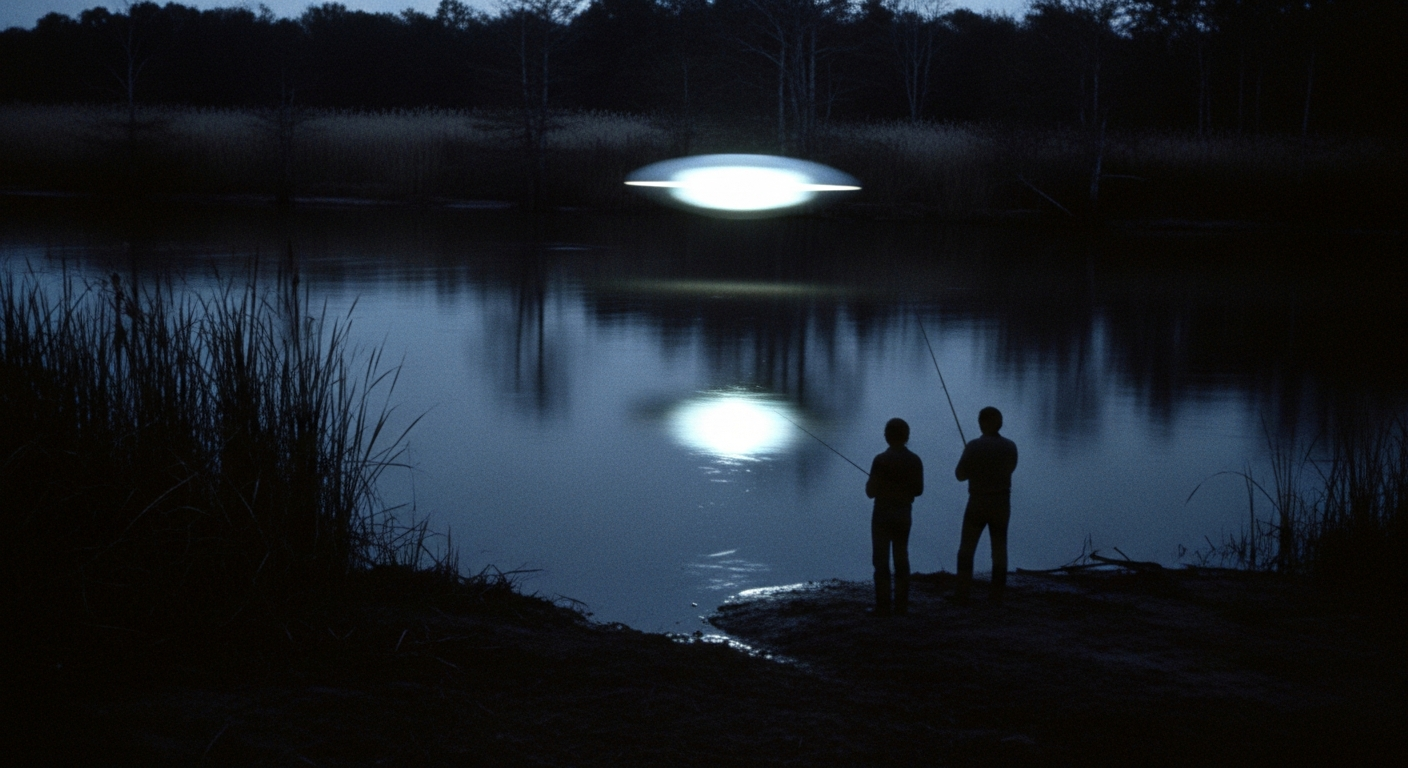
Lost Hours Over the Bay: The Night a Mississippi Couple Were Taken from a Fishing Pier
QUIRK REPORTS — OFFICIAL CASE REPORT
Case Number: QR-2026-73765
Title: CLAWS FOR CONCERN: THE PASCAGOULA RIVER ABDUCTION
Two Mississippi Shipyard Workers. Forty Missing Minutes. And a Tape Recording That Nobody Was Supposed to Hear.
Classification: Alien Abduction — CE3K (Close Encounter of the Third Kind) / CE4 (Physical Abduction)
Date of Event: 11th October 1973
Location: West Bank, Pascagoula River, Pascagoula, Mississippi, USA
Witnesses: Raymond Dubois (age 42) & Chester Walcott (age 18)
Reporting Investigator: Fox Quirk, Founder & Senior Field Reporter, Quirk Reports
This report is based on documented paranormal accounts. Names and identifying details have been changed to protect those involved.
SECTION ONE: WITNESS STATEMENT
The evening of October 11th, 1973 had begun as unremarkably as any other Thursday. Raymond Dubois, a forty-two-year-old veteran shipyard worker, and Chester Walcott, his eighteen-year-old colleague, had settled on the west bank of the Pascagoula River with their fishing rods and the quiet understanding of men who didn't need much conversation to enjoy each other's company. It was their routine. It was ordinary. It was, until approximately nine o'clock that evening, entirely without incident.
Raymond noticed it first. A blue-white light appeared downriver — no boat lantern, no passing aircraft, but something pulsing with cold mechanical regularity. It drifted closer, accompanied by a high-pitched zipping hum that cut clean through the sounds of the water and the insects. Chester turned from his rod and froze.
The craft that now hung above them was oval, thirty to forty feet in length, hovering silently some ten feet above the river's surface with a blue haze bleeding from beneath its hull. It had no wings, no visible means of propulsion. A hatch opened in its side, and three figures emerged.
Both men, questioned independently and with no opportunity to collaborate, described what came next in near-identical terms. The creatures were approximately five feet tall, grey and wrinkled in complexion, moving with a stiff mechanical fluidity that suggested walking was not their preferred mode of locomotion. Their hands were not hands — they were fused, pincer-like claws, crustacean in character. Their faces offered only slits where features should have been: no discernible nose, a mouth-like opening, and strange carrot-shaped protrusions in place of ears.
Neither man ran. Raymond later suggested paralysis — whether physical or psychological he could never determine with certainty. Chester described an overwhelming floating weightlessness that seemed to rise through his body from the ground itself. The creatures approached without urgency.
The forty minutes that followed exist, for both men, only in fragments. Raymond recalled being transported into the craft — not via ramp or stairway, but instantaneously — into a space bathed in white light that appeared to emanate from the walls themselves. He lay on a platform while something he described only as a device moved over and around him in examination. He felt no pain and no physical touch. He described the terror as dreamlike — present, but held at arm's length by some quality he could not name.
Chester's interior account echoed the structure of Raymond's while differing in detail. He recalled a white, featureless room that seemed impossibly large for the craft's external dimensions, and a single creature that regarded him with what he interpreted, with considerable unease, as scientific curiosity.
Then they were on the bank again. The craft was gone. The insects were still singing. Raymond checked his watch: nine forty-five.
After a long silence, Chester began to shake. Raymond — a man who had not wept since his mother's funeral twelve years earlier — found himself, in his own halting words to investigators, "very close to crying."
They drove to the Pascagoula Police Department, where Raymond sat across from a desk officer and described the evening in a voice, witnesses noted, entirely stripped of performance. Sheriff Fred Diamond, brought in to assess the situation, made a decision that would become legend in UFO research circles. He left the two men alone in an interview room with a recording device running — a fact he did not disclose to them. His reasoning was straightforward: if they were fabricating the story, they would begin to unravel it the moment authority stepped out.
They did not unravel it. On the tape, they were simply afraid. Chester urged Raymond not to tell anyone, foreseeing ridicule. Raymond said he couldn't stay silent — people needed to know. At one point Chester said quietly that he wished he were dead — not from despair, but because what he had experienced felt so wholly outside the frame of ordinary human life that re-entry into that life seemed almost impossible to imagine.
The case leaked within days and became, briefly, the most discussed abduction report in America. Both men were examined by physicians — no physical injuries were found. Hypnotic regression sessions, conducted by researchers from the Aerial Phenomena Research Organisation, produced accounts consistent with the men's conscious recollections rather than amplifying or embellishing them, which investigators noted as significant.
Dr. James Harder found both men credible, Raymond exhibiting physiological markers — elevated heart rate, pallor, trembling hands — consistent with genuine traumatic recall. Dr. J. Allen Hynek, the astronomer who coined the phrase 'Close Encounter of the Third Kind' and who had spent years professionally debunking UFO reports, interviewed the men and stated publicly that the Pascagoula case was one he could not explain away.
Raymond Dubois spent the remainder of his life holding a question that no investigation ever answered. Chester Walcott returned, as best he could, to private life. He gave very few interviews after the initial storm. The tape is preserved. On it, Chester's voice drops to barely a whisper.
"I know somethin' did. I know somethin' did. That's all I know."
SECTION TWO: EVIDENCE
- Audio Recording (Undisclosed): A recording made covertly by Sheriff Fred Diamond of the two witnesses left alone in the Pascagoula Police Department interview room. Both men continued to express fear and distress consistent with genuine traumatic experience rather than fabrication. This tape has been analysed by researchers for decades and remains one of the most compelling pieces of secondary evidence in any abduction case on record.
- Corroborating Expert Testimony: Dr. J. Allen Hynek — scientific consultant to the USAF's Project Blue Book and one of the most rigorous sceptics in mid-century UFO research — declared the case unexplained and the witnesses credible. Dr. James Harder of the University of California independently assessed both men as exhibiting genuine physiological stress responses.
- Hypnotic Regression Results: Sessions conducted by the Aerial Phenomena Research Organisation produced accounts consistent with the witnesses' conscious recollections. Researchers noted this consistency as significant, given hypnosis's known tendency toward embellishment rather than faithful reproduction.
- Independent Corroboration of Descriptions: Both men, questioned separately and without opportunity to confer, produced near-identical descriptions of the craft, the creatures, and the interior of the vessel.
- Absence of Physical Evidence: Sheriff Diamond's subsequent examination of the riverbank found the scene undisturbed — fishing rods still propped in the mud, no physical traces of the craft or the encounter. No physical injuries were identified on either witness by attending physicians.
- No Blood Alcohol Evidence: Sceptical claims that the men had been drinking were never substantiated by any toxicological evidence.
SECTION THREE: FOX'S ANALYSIS
Folks, I've been in this business long enough to know when a case is trying to wriggle out of my grasp, and the Pascagoula Abduction is slippery in all the right ways. Let me tell you — when Allen Hynek, the man who spent years being the government's designated UFO-debunker, walks away from an interview shaking his head and saying he can't explain it, that's not nothing. That's a very loud something wearing nothing's hat.
Let's talk about that tape. Sheriff Diamond thought he was setting a trap, and in a sense he was right — he just caught something he didn't expect. Two frightened men, alone, with no audience to perform for, continuing to be afraid. Chester Walcott wishing he were dead — not dramatically, not for effect, but quietly, in the way a person says something when they've run out of better words for an experience that has no adequate ones. I've interviewed a lot of witnesses in my time. I know what performance looks like. That tape doesn't sound like performance. It sounds like two people trying to survive something they don't have the language for.
Now, I have a personal and well-documented grievance with extraterrestrial entities and their cavalier approach to biological examinations — I will not be elaborating further, my therapist has advised against it — but I want to be clear that my feelings don't cloud my reporting. I take every case on its evidence. And the evidence here, while not physically conclusive, is about as robust as you'll find in this field. Multiple witnesses. Independent corroboration. Expert endorsement from people with serious professional reputations to lose. A covert recording that should have destroyed the story and instead preserved it.
The crustacean-claw detail is fascinating to me. You'd think, if you were fabricating an alien encounter in 1973, you'd reach for the classic grey — big eyes, smooth skin, the full Roswell package. The crab-claw creatures are weird in a way that feels almost too weird to invent. They're not cinematic. They're not elegant. They're deeply strange, and the fact that both men described them independently in the same terms is either an extraordinary coincidence or an extraordinary event.
Could there be a mundane explanation? The sceptics offered several: shared hallucination, chemical exposure from the shipyard, deliberate fabrication. None of these fully account for the evidence — particularly the covert recording, which is the part that keeps me up at night. Or rather, one of the parts. I also can't stop thinking about Chester's line on that tape. There's something about the plainness of it that I find more convincing than any amount of dramatic testimony. "I know somethin' did. That's all I know." You can't write that. Well — you can, but you wouldn't. It's too quiet. Too defeated. Too real.
My professional instinct says this case deserves its reputation. You could say it's got real claws to it. And much like those creatures on the riverbank, it just doesn't let go.
I'll see myself out.
SECTION FOUR: CREDIBILITY RATING
Rating: 8.5 / 10
Reasoning:
- Multiple Witnesses (+2): Two individuals from different generational backgrounds, questioned separately, producing near-identical accounts is statistically and psychologically significant.
- Covert Recording (+2): The undisclosed tape recording of the men's private conversation represents an extraordinarily rare form of unguarded corroboration. Their continued distress in the absence of an audience is among the most compelling secondary evidence in any case on file at Quirk Reports.
- Expert Endorsement (+1.5): The credibility assessments of both Dr. Hynek and Dr. Harder — neither of whom were credulous investigators — carry considerable weight.